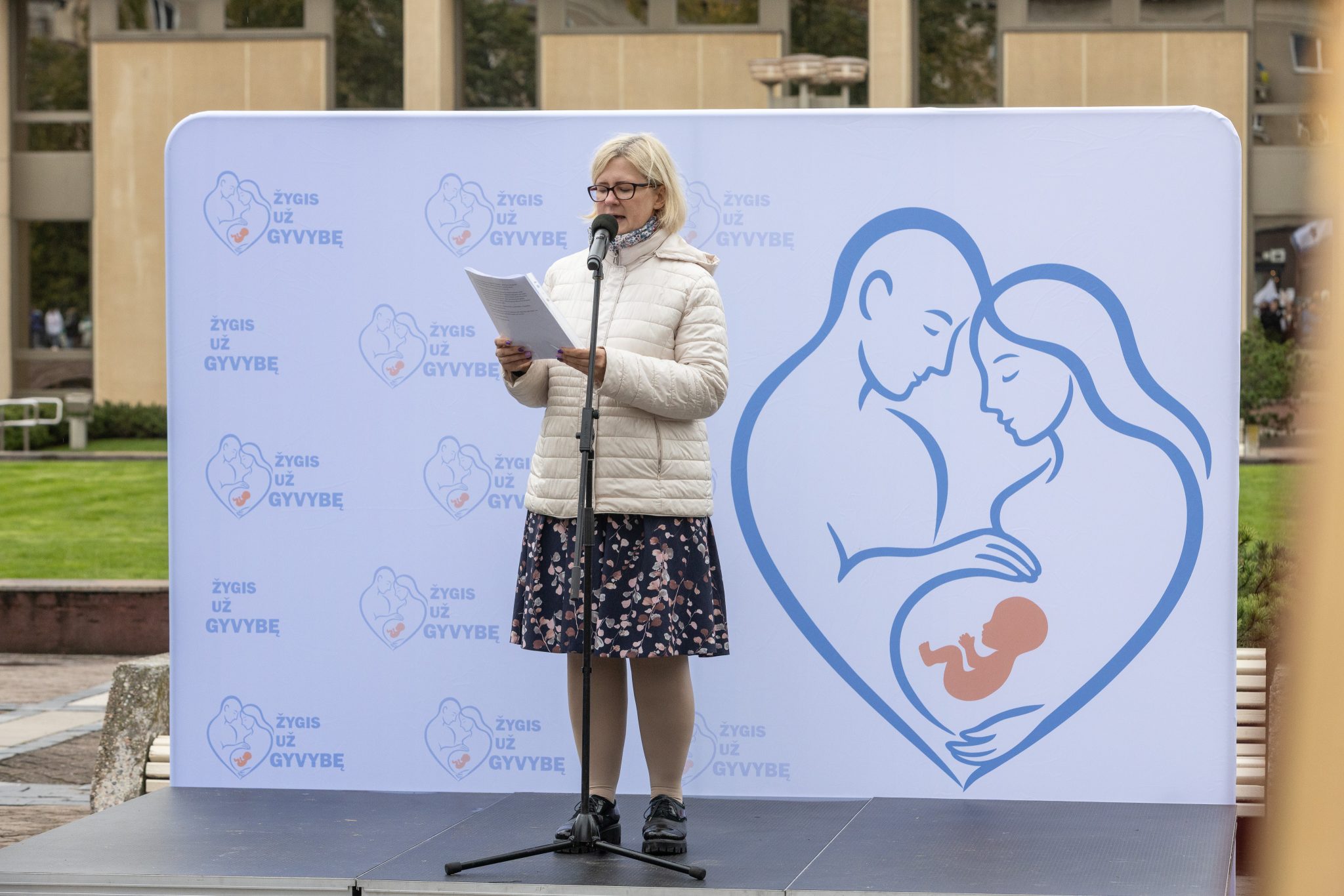
H.E. Apostolic Nuncio to the Baltic States, Archbishop Dr. Georg Gänswein
Lecture in Šiluva on September 4, 2025, at the conference “How Not to Destroy Freedom and Democracy: Reflecting on the Šiluva Declaration.”
The topic „Faith, Reason, and Relativism” is of great relevance today – a time where politics are increasingly taking on religious forms, and the dimensions of faith become more and more political.[1] Currently, there is a tendency to ‘believe’ in politics, while the preaching of the church increasingly tends to focus on political issues. Relativism, which already dominates large parts of public life, further adds to this confusion, leaving not only society but also believers feeling unsettled.[2] Against this background, it is worth recalling the words of Cardinal Ratzinger, which resonated around the world 20 years ago. During the Holy mass that marked the beginning of the conclave held in 2005, he spoke about the great danger posed by relativism. In this context, he quoted the Epistle to the Ephesians when he described being „tossed by waves and swept along by every wind of teaching” (Eph 4:14).[3] Freely translated, we could say that everything is permitted, yet we are compelled to remain indifferent toward the truth, especially the revealed truth. This inevitably leads to the erosion and ultimately the destruction of a faith based on the confession of truth. And this leads to a poisoning of faith. As a remedy, Ratzinger once again reminded the Church of the greatness, beauty and importance of truth.
The following aims to show, from the perspective of Joseph Ratzinger / Benedict XVI, why it is in keeping with the dignity of reason to be orientated toward truth – and why, in the end, only the truth will set us free (cf. John 8:32). In this way, important insights are offered that help us understand why neither the Church nor the world can endure when detached from the truth.
-
Introduction to the Topic
„Faith and Reason” is a constant theme in Ratzinger’s work. Already in the early years of his scientific activity, he understood the crucial importance of the interplay between faith and reason, as well as the need for a correct understanding of both. When reason or faith wither away, this inevitably leads to pathologies and to the disintegration of the human person.
Joseph Ratzinger was an attentive observer of the current developments of his time. As early as 1961, he identified two major challenges: the belief in technological progress and globalization.[4] He also observed the emergence of a „technical monoculture”, clearly evident in today`s dependence on social communication media: a kind of „universal spiritual language” – which today is English, and which marks the world`s entry into a new stage of uniformity. Due to this changed situation, there soon was a call to respond to it. This, in turn, called for new forms of proclamation, liturgy, and teaching. Science began to be endowed with an almost religious meaning – one that, through the rise of a technocratic monoculture, threatened to absorb everything else. Traditional faith, based on divine Revelation, was met with increasing scepticism. Furthermore, the outstanding cultural heritage of the Western world was undermined by relativism, the experience of globalization and standardization. Novelty was welcomed with exuberant joy. The commitment to truth played an increasingly minor role, with practice and progress setting the tone.[5]
Many, including a large number of theologians, could not resist the temptation to be like everyone else. Reason was allegedly upheld, and a “scientific” approach was embraced; and yet, paradoxically, reason itself was denied its capacity to apprehend the truth. Before the Second Vatican Council, Joseph Ratzinger had outlined this development in detail, pointing to a process that would fundamentally alter the way modern humanity perceives reality: The immediacy of nature and thus of reality is lost; everything is perceived through the filter of technology. How very true this analysis has proven to be.[6]
-
Limitation of Reason and its Dignity
These remarks show how radically perception has changed in modern times. Truth is no longer defined by its conformity to reality, but rather by its feasibility. This fateful decoupling makes people susceptible to manipulation, a process that is further exacerbated by the digital world. Partly responsible for this is a self-imposed limitation of reason, which is no longer able to take its measure from being, from the logos. In his book Introduction to Christianity, Joseph Ratzinger outlined this development in a very convincing way. A turning point was reached. Now technical thinking had taken over, and faith – so it was claimed – had given way to science. The Marxist axiom gained the upper hand, according to which practice became the guiding criterion, while everything else had to be subordinated to it – including teaching. Thus, in the name of progress and scientific rigour, it was not uncommon to justify things that were neither progressive nor scientific. The following example may illustrate this.
Under the guise of being ‘scientific,’ a claim was made to replace faith with knowledge and to close the bridge to the world. As a result, supernatural revelation lost its significance as a reference point for theology, being increasingly replaced by secular sciences. This led to a process that can be described as a ‘reversal of all values.’ No longer was divine Revelation the reference point, but rather the principles of an immanent science, which were soon replaced by the concrete living conditions of men. Reason became confined to the here and now, and thus, ultimately, its capacity to grasp the truth was denied.
Joseph Ratzinger summarizes this development as follows: „The truth human beings deal with is neither the truth of being nor, ultimately, that of its past deeds, but rather the truth of changing the world, of shaping the world – a truth related to the future and to action.“[7] A self-restricted reason is incapable of elevating the spirit to God. In the early 1960s, Ratzinger warned that this would lead to an alienation from the „most original sources of religious existence.“[8] And he concludes: “Thus, instead of the one true God, many false gods arose, the worship of the work instead of the one who made it (Romans 1:21-26). […] Thus, technical religio, that is, the worship of man for himself, automatically takes the place of natural religion: the self-deification of humanity replaces the deification of nature with inner necessity.”[9] Ultimately, man and nature are deified. Man, who by his nature – as Augustine says – is oriented towards God, is thus deprived of his natural ability and rendered incapable of reaching God (incapax Dei). Since he commits himself to immanence, he is unable to recognize and love Him. The only way out is relativism, which is the result of weak reasoning.
Based on his earlier insights, [10] Joseph Ratzinger continues: „But this also means that the new paganism, which, for a century, has developed in the heart of the Christian world, is fundamentally different from the earlier one: There are no more gods; instead, the world has been irrevocably de-divinized and profaned. Only humans remain on the scene, and they now feel a kind of religious reverence for themselves, or at least for that part of humanity to which we owe our technological progress.”[11] Worse than the profane is the reduction of reason, which can, at best, only rotate around itself because it has been deprived of the ability to elevate itself to the supernatural. Instead, human beings and concrete living conditions take centre stage. Man becomes the measure of all things, the measure of the divine is lost.
The problem is that this process is very subtle. The self-restraint of reason is hardly perceived as such; on the contrary, invoking science brings a sense of reassurance. The consequences become most apparent in a disturbed functioning of spiritual life.[12] Today, many people turn to psychologists because their psyche (soul) is ill. This fact clearly shows that something fundamental is wrong. For if reason has no access to God, then religion has „no place in the realm of reason.”[13] Faith would become irrational or merely natural.
The developments outlined by Joseph Ratzinger in his Introduction to Christianity have far-reaching consequences. Due to the self-limitation of reason, access to the supernatural was denied. As a result, faith was initially replaced by science, and then by politics. This gave politics a religious dimension, while faith became more and more political. This development caused a rift between scientific-political theology and the faith of ordinary believers, who increasingly turned away from it in order not to lose their faith. This has created a huge divide, which is further widened by the fact that so-called ‘scientific theologians’ ridicule the faith of ordinary believers and speak of it in a derogatory manner.
In this regard, Pope Benedict XVI. was a true bridge-builder. He tried to find a remedy because the faith of the simple is the true treasure of the church. He was convinced that something essential is missing when man is deprived of the truth. In his “Regensburg lecture”, he called for an expanded reason. It must free itself from self-limitations and regain its greatness which corresponds to man. He said at the end of his lecture: „The West has long been endangered by this aversion to the questions which underlie its rationality, and can only suffer great harm thereby. The courage to engage the whole breadth of reason, and not the denial of its grandeur – this is the programme with which a theology grounded in Biblical faith enters into the debates of our time. „Not to act reasonably, not to act with logos, is contrary to the nature of God”, said Manuel II, according to his Christian understanding of God, in response to his Persian interlocutor. It is to this great logos, to this breadth of reason, that we invite our partners in the dialogue of cultures. To rediscover it constantly is the great task of the university.”[14] We can add that only when reason regains its greatness and breadth, even relativism can be overcome.
-
Faith, Supernatural and Forward-Looking
What has been said about reason equally applies to faith. In recent decades, little importance has been given to faith, even in theology – although theology is impossible without faith. Even here, the so-called scientific approach has left traces of devastation, with theologians striving to replace faith with science. Thus, faith is deprived of its supernatural character and reduced to a private matter, resulting in the banishment of faith from public life. The effects of this disastrous misunderstanding of what theology is, are becoming increasingly apparent today. As a result, fewer and fewer Christians know their faith; they have become, in effect, neo-pagans.
What has now become a sad reality was already anticipated by Professor Ratzinger in the 1960s. To describe this process, he drew on a Brothers Grimm fairy tale “Hans im Glück”. In the foreword to his Introduction to Christianity, he uses this story to illustrate how believers gradually drift away from their faith. The fairy tale tells the story of Hans, who, as payment for seven years of work, receives a lump of gold. He gradually trades it away for less valuable things that seem more convenient to him. In the end, just before reaching home, he is left with only a grindstone, which he throws into a well. Thus, he ends up with nothing, but rejoices in his newfound freedom. Already in the 1960s, Professor Ratzinger asked: “Has theology not gradually downplayed the demands of faith — demands that were once felt as too burdensome — step by step, always just enough so that nothing essential seemed lost, yet always enough to allow the next step to be taken? And will poor Hans, the Christian, who trustingly allowed himself to be led from one exchange to another, from one interpretation to the next, not soon find himself holding nothing but the grindstone instead of the gold he began with – a grindstone that he can be safely advised to throw away?[15]
That is exactly what happened. The treasure of faith, which, according to the Apostle Paul, we carry in earthen vessels (cf. 2 Cor 4:7), has been lost by many – misled by theologians who have strayed from the truth of Christ. Joseph Ratzinger identifies this as a twofold problem characteristic of the modern era, which the following discussion will address.
3.1. The Dilemma of Faith
From early on, Joseph Ratzinger succeeded in identifying the fundamental difficulty in passing on faith in the modern age: the gap between the ‘visible’ and the “invisible”. Even though Christians, in their Creed, profess their belief in the ‘invisible world’, this part of the Creed seems to have been surpassed by modern scientific understanding, thus appearing unreal.[16] Terms such as “invisible” and “supernatural” almost cry out for de-mythologization. Ratzinger refers to the growing divide between the visible and the invisible as the primary scandalum of faith. Anyone who speaks of an invisible reality inevitably provokes contradiction. Yet revelation – the heart of the Christian faith – is precisely the manifestation of the invisible God.
Ratzinger describes this difficulty as follows: „Today, we are inclined from the outset to simply assume that what is tangible, what is ‘verifiable’, is what is truly real.” And he continues: „But is that actually allowed? Shouldn’t we ask more carefully what ‘the real’ actually is? Is it only what has been established and can be established, or is establishing perhaps only a certain way of relating to reality, which by no means can grasp the whole and which even leads to a distortion of truth and human existence if we accept it as the sole determining factor?”[17] A few pages later, Ratzinger answers these questions himself: „Christian faith […] means the option that the Unseen is more real than the Seen. It is the confession to the primacy of the invisible as what is truly real, which sustains us and therefore enables us to face what is visible with relaxed serenity – in accountability to the invisible as the true foundation of all things.”[18]
The following is worth noting: Whoever gives up the scandal of faith gives up the faith through which the invisible world becomes visible. This highlights the dilemma in which large parts of theology still find themselves. Strictly speaking, the alternative remains between abolishing faith in the name of faith, or accepting the scandal of faith. An urgent correction in the spirit of Joseph Ratzinger is needed here. The inner logic and beauty of faith only come to bear when faith is accepted in its entirety, which undoubtedly includes the invisible world.
3.2. The Gift of Faith
Finally, attention should be focused to faith. Joseph Ratzinger/Benedict XVI noted that when we talk about faith today, there is a fundamental difficulty: „The problem with the word “believe” is that it refers to two completely different mental attitudes. In everyday language, to believe means “to think, to suppose”, i.e. a preliminary stage of knowledge in relation to things about which no certainty has yet been reached.”[19] But belief in God is neither a hypothesis (assumption) nor a mere opinion, for no one would be willing to give their life for it, as the martyrs did.
Joseph Ratzinger defines faith as follows: “Faith itself is an anticipation. It anticipates what is actually still unattainable for us.”[20] This captures the heart of the matter: through faith man accepts the Revelation of God and thus God himself. The Logos, the Revelation of God, is unsurpassed knowledge, true reason, and meaning. Access to this knowledge is also of a different kind. In other words, faith is not primarily about academic knowledge, but about the gracious acceptance of God, which precedes all knowledge. Joseph Ratzinger writes: „The reality that occurs in Christian Revelation is nothing and no one other than Christ himself. He is, in the true sense, the Revelation: “Whoever sees me, sees the Father,” says Christ in John (14:9). Accordingly, receiving revelation is synonymous with entering into the reality of Christ.[21] However, modern man finds this difficult; he is accustomed to thinking in abstract, academic and often positivistic terms, which is made even more difficult by the reduction of reason. But this often closes the door to faith. Faith becomes possible when the believer enters into a living relationship with God, as expressed in the Gospel of John, which reads: ‘Now this is eternal life, that they should know you, the only true God, and the one whom you sent, Jesus Christ’ (John 17:3).
Ultimately, faith is linked to a life decision that becomes reality when knowledge of truth and love meet. Ratzinger develops this theme based on a dialogical approach, especially since faith only becomes possible through entering into a relationship. Thus, faith is an anticipation of heaven, which is the perfect form of encounter. It is fulfilled in communion with God, the communion between God and man in the mystical body of the Church.
Summary
Faith, reason and relativism are topics that are of fundamental importance for faith and the transmission of faith. It is to the great credit of Joseph Ratzinger/Benedict XVI that he has produced groundbreaking analyses and statements on these topics, which provide guidance on how the current crisis of faith can be overcome.
Against the backdrop of the great challenges of our time, technical thinking and globalization, the first step must be to regain the breadth of reason.
Reasonable means truthful. Relativism is an expression of weak and narrow-minded reasoning. It is based on the false pride that humans cannot recognize the truth and the false humility of refusing to accept it. The truth sets us free (cf. John 8:32) because it is the standard by which humans must measure themselves; accepting it requires humility.
Thus, it becomes clear why the knowledge of truth cannot be a purely academic act. Man is not a computer that stores the truth like algorithms. He is capable of truth and will find the truth if he conforms to the truth. According to Saint Thomas Aquinas, rectitudo – uprightness – precedes all virtues.[22] Accordingly, in the long run, reason cannot be rightly guided (recta ratio) if one’s own life is in contradiction to the truth. Such an attitude leads to a dead end, through which the foundations of faith are lost.
Faith is forward-looking because it anticipates what is and what awaits us. Christian faith is therefore the option that the unseen is more real than the seen. The Logos, the divine revelation, precedes all thought and contains that unsurpassed knowledge through which reason receives its dignity and life its meaning. Faith therefore means entering into a living relationship with God.
From this perspective, the danger posed by relativism as the mindset of modernity becomes clear. It acts like a creeping poison. Instead of setting out to face the liberating and, at the same time, challenging power of truth (cf. John 8,32), man withdraws into his own self-sufficiently. This is fuelled by the use of social media. At first glance, people rejoice – like ‘Hans in Luck’ – because life becomes more comfortable and pleasant. In reality, however, this is precisely what prevents people from fulfilling their destiny, making them unfree. Relativism would cement such a mindset and, in doing so, create the social and legal conditions for the spiritual unfreedom of man. Yet precisely in this way, humanity risks missing its true goal: to come to the knowledge of the truth – which is God – and thus to attain eternal life.
_______________________________________________
Reference:
[1] Fundamental for the topic dealt with is the outstanding study of Gediminas T. Jankunas, The Dictatorship of Relativism. Pope Benedict XVI`s Response, New York 2010, 101-268.
[2] Ralph Weimann, Glaube und Vernunft im Denken Joseph Ratzingers. Ein Ausblick, in: Forum Katholische Theologie 26 (1/2010), 58-69. My explanations are based on the considerations of this article.
[3] Joseph Ratzinger, Missa Pro Eligendo Romano Pontefice, 18.04.2005. See Gediminas T. Jankunas, Dictatorship of Relativism, 193-208
[4] Joseph Ratzinger, Das Konzil und die moderne Gedankenwelt, in: Joseph Ratzinger, Gesammelte Schriften (= JRGS) 7/1, 73-71, bes. 76.
[5] Ibid., 79. See Gediminas T. Jankunas, Dictatorship of Relativism, 69-77.
[6] See Ralph Weimann, Anstößiger Wahrheitsanspruch. Über die Versuchung wie „alle anderen“ sein zu wollen, in: Neue Ordnung 69 ((3/2015) 164-176.
[7] Joseph Ratzinger, Einführung in das Christentum, in: JRGS 4, 31-322, 75. See Gediminas T. Jankunas, Dictatorship of Relativism, 132-143.
[8] Joseph Ratzinger, Das Konzil und die moderne Gedankenwelt, in: JRGS 7/1, 82.
[9] Ibidem.
[10] Joseph Ratzinger, Die neuen Heiden und die Kirche, in: JRGS 8/2, 1143-1158. See Gediminas T. Jankunas, Dictatorship of Relativism, 101-119.
[11]Joseph Ratzinger, Das Konzil und die moderne Gedankenwelt, 83.
[12] Ibid., 83.
[13] Joseph Ratzinger, Der Gott des Glaubens und der Gott der Philosophen Ein Beitrag zum Problem der theologia naturalis, in: JRGS 3/1, 189-210, 193.
[14] Benedict XVI, Faith, Reason and the University. Memories and Reflections, Lecture of the Holy Father, University of Regensburg 12 September 2006. See G. T. Jankunas, Dictatorship of Relativism, 250-258. See Gediminas T. Jankunas, Dictatorship of Relativism, 261-266.
[15] Joseph Ratzinger, Einführung in das Christentum, in: JRGS 4, 31-322, 31
[16] Ibid., 65-70.
[17] Ibid., 70.
[18] Ibid., 84.
[19] Joseph Ratzinger, Glaubensvermittlung und Glaubensquellen, in: JRGS 9/2, 929-950, 938.
[20] Ibid., 937.
[21] Joseph Ratzinger, Ein Versuch zur Frage des Traditionsbegriffs, in: JRGS 9/1, 391-431, 403. See Gediminas T. Jankunas, Dictatorship of Relativism, 247-258.
[22] Thomas von Aquin, STh I-II, q. 61, a. 1.